

Guatemala Maps & Facts
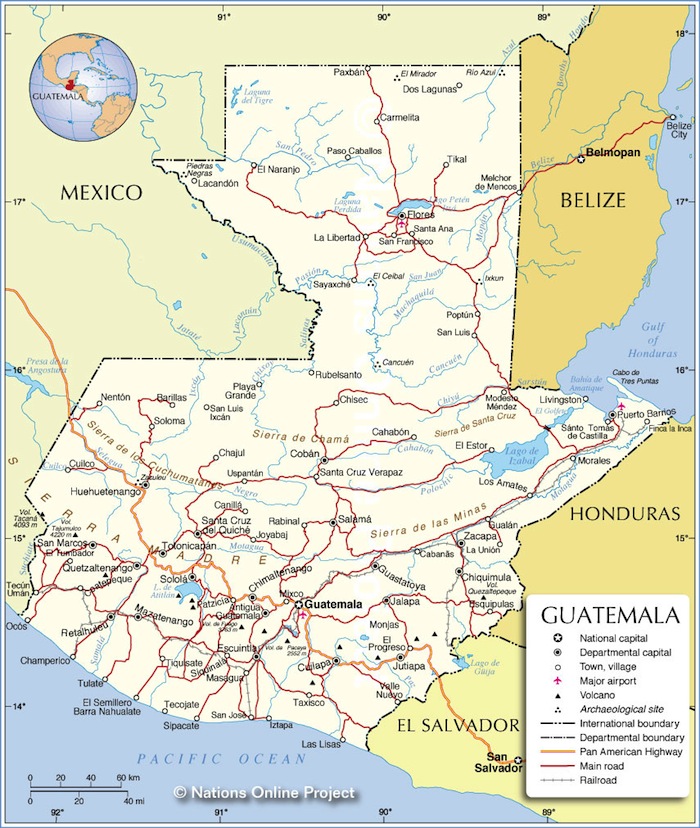
Map of Guatemala ©Nations Online Project
Size: 41,699 sq. miles, size of Tennessee
Population: 15,470,000 (2013)
Capital: Guatemala City
People: Over half are indigenous Maya; the rest are primarily of mixed Maya and Hispanic heritage, called Ladinos; small population of African descendents (including Garifuna) along Atlantic Coast
Languages: Spanish is the official language; there are 22 Mayan languages spoken as well as Xinca and Garifuna
Religions: Roman Catholic, Protestant (primarily evangelical) and Maya
Independence: 1821 (from Spain)
- Over half the population lives below poverty level.
- Illiteracy, infant mortality and malnutrition rates are among the highest in Latin America.
- Life expectancy is among the lowest in Latin America.
- Nearly one third of all children do not complete primary school.
- All social indicators are worse for the Maya population than for the Ladino.
- The country is plagued by gang and drug related violence and organized crime. It serves as a major corridor for drugs coming to the US from South America.
Quick Facts About the War
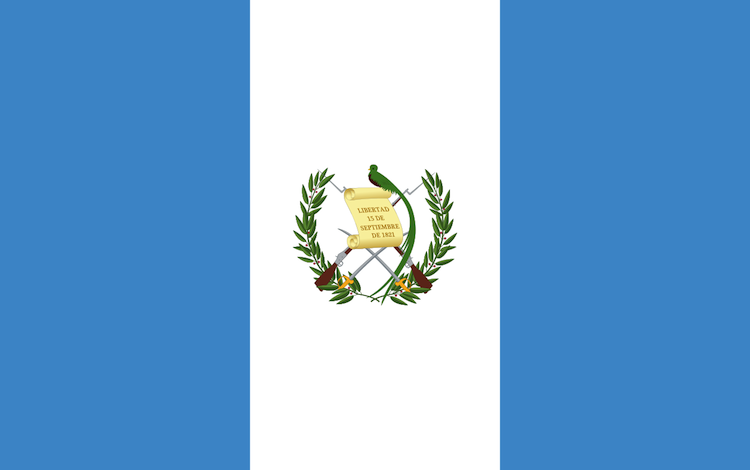
Flag of Guatemala.
Dates: 1960 – 1996 (36 years)
In 1982, the four most important Guatemalan revolutionary organizations fighting against the military regimes and paramilitary right-wing groups created the Guatemalan National Revolutionary Unity (URNG).
Over 200,000 people were killed or disappeared
1.5 million were displaced
669 massacres
83% of victims were Maya & 17% of victims were Ladino
The Turth Commission found that Army and security forces were responsible for 93% of atrocities; the insurgency (guerrillas) for 3%; the remaining 4% were undetermined.
Historical Timeline
2500 BCE – 1501 CE - Maya civilization begins around 2500 BCE and reaches its peak of development beginning around 200 CE. Maya achievements in mathematics, astronomy, architecture, engineering, art, language and agriculture are notable. Around 900 CE Maya cities suffer a decline.
1501 – 1821 – Spanish conquerors began sweeping through the continent. Between 1524 and 1650, about 85% of Maya are killed by weapons and diseases. Many survivors are enslaved, but some flee to the higher mountains. Ceremonial centers are torn down and replaced with Christian churches. Maya leaders and scholars are killed, writings are destroyed.
1821 – 1900 – On September 15, 1821, Guatemala declares independence from Spain. From 1823 -1840, it is part of the United Provinces of Central America (along with El Salvador, Honduras, Nicaragua and Costa Rica). In 1947, Guatemala declares itself an independent republic. Conservatives and Liberals dominate Guatemalan (and Central American) politics. Conservatives represent the interests of wealthy landowners and the Catholic Church, favoring strong central government and a regulated economy. Liberals represent mainly the middle class and merchants, favoring decentralized government, free trade and greater separation of church and state. During the mid-1800s, cultivation and export of coffee creates a new oligarchy of wealthy families.
1900 – 1944 – By 1900, the United States is the dominant economic force in Guatemala. The United Fruit Company becomes the largest landowner, employer and exporter in Guatemala, persuading the government to provide them with land, low taxes and cheap labor. While United Fruit’s profits flourish, most the population suffers malnutrition, high rates of infant mortality, limited access to health care and education and violations of human rights. This leads to wide-scale discontent. The middle class also is frustrated with its own limited economic growth and political power.
1944 – 1954 – Ten-year period of social and democratic reforms, including establishment of a social security system, minimum wage, the legalization of unions, laws to protect workers and national health care. The United Fruit Company and other large landowners threatened by land reform which redistributes their unused lands to landless peasants.
1954 – CIA led coup, promoted by United Fruit and “justified” with Cold War rhetoric, replaces freely elected President Jacobo Arbenz with Colonel Carlos Castillo Armas. The coup is a turning point in modern Guatemalan history, paving the way for decades of repressive military dictators. Castillo repeals the land reform law, represses labor unions and reverses most other social reforms. Widespread crackdown on labor leaders and peasants.
1960 – The beginning of Guatemala’s civil war between government military forces and primarily left-wing insurgents. Peasant, student, community, labor, church and other groups organize and protest nonviolently in the streets. The government responds with increasing repression, using military as well as paramilitary forces, that become known as death squads. In the following two decades, as repression continues, armed insurgents known as guerrillas gain strength, especially in the Maya highland region.
1976 – A severe earthquake kills over 25,000 people and leaves a million homeless, exposing massive social inequities. Anti-government organizing activities increase.
1978 – General Romeo Lucas García becomes president in openly rigged election. Protests and strikes erupt and student and labor leaders, even priests, are assassinated. Peasant groups are massacred.
1982 – Four guerrilla organizations form the Guatemalan National Revolutionary Unity (URNG).
General Efraín Ríos Montt seizes power in a coup and escalates the repression into a “scorched earth” campaign, aimed primarily at certain Maya highland regions where the guerrillas are active.
1983 – Ríos Montt is ousted by General Oscar Mejía Víctores but the bloodshed continues. Terror is everywhere as thousands of people are killed or disappeared. Entire villages are massacred, including men, women and children.
1986 – Vinicio Cerezo, a civilian, assumes the presidency following a legitimate election. The violence diminishes, but does not stop, as the military still wields great power.
1992 – Rigoberta Menchú, a defender of human and Maya rights, wins the Nobel Peace Prize.
1996 – The 36-year long civil war formally ends with a Peace Agreement.
1998 – Bishop Juan Gerardi is assassinated two days after presenting “Guatemala: Never Again!” a report by the Catholic Church on human rights violations during the war, which concludes that 90% were committed by government forces and their paramilitary bands.
1999 – The United Nations sponsored Truth Commission report states that 93% of all human rights violations during the civil war were committed by government security forces; that approximately 200,000 people were killed or disappeared; and that over 600 massacres were carried out.
2006 – Government and UN set up a commission known as CICIG to fight impunity by prosecuting high level criminals. Crime, social injustice and human rights violations continue to afflict Guatemala.
2009 – An ex-military officer and a retired colonel are the first people convicted of crimes committed during the civil war.
2013 – Following an historic trial, former President Ríos Montt is found guilty of crimes against humanity and genocide. Shortly thereafter, the Guatemala Constitutional Court annuls the judgment and orders a new trial.
2015 – Revelations by CICIG of governmental corruption provoke massive protests and demonstrations, resulting in the resignation of both the president and vice president, who are sent to prison. Former comedian Jimmy Morales, whose slogan is “not corrupt nor a thief,” is elected President.
2016 – Former military soldiers are convicted of sexual violence toward and enslaving 15 Maya women during the civil war.